
Jennifer Galbreath has achieved a major milestone, advancing to PhD Candidacy (ABD) in Spring 2025 after successfully passing her Dissertation Proposal and Comprehensive Exam. Her dissertation work is being conducted in Alaska and involves a collaboration with Connecting Health Innovations (CHI). Connecting Health Innovations was founded in 2013 by Dr. James Hébert, MSPH, ScD, who also serves as a Health Sciences Distinguished Professor and Director of the Cancer Prevention and Control Program in the Department of Epidemiology and Biostatistics at the Arnold School of Public Health – University of South Carolina. Dr. Hébert invented the Dietary Inflammatory Index™ (DII®), which estimates the inflammatory potential of a diet and can be used as a tool in understanding how to reduce chronic inflammation in the body, as chronic inflammation is intricately connected to the development of chronic disease. Jennifer has worked with CHI to have DII® scores computed for young child dietary intake in urban Alaska and will explore the relationship between household food security status and the dietary inflammatory potential of the child diet. The research also includes understanding the relationship of specific food assistance opportunities in Alaska with household food security status and child diet quality. Jennifer is intrigued by some of the preliminary results, which may be useful in future community-level efforts to ensure specific food assistance programs are available, accessible, and provide families with healthy food options.
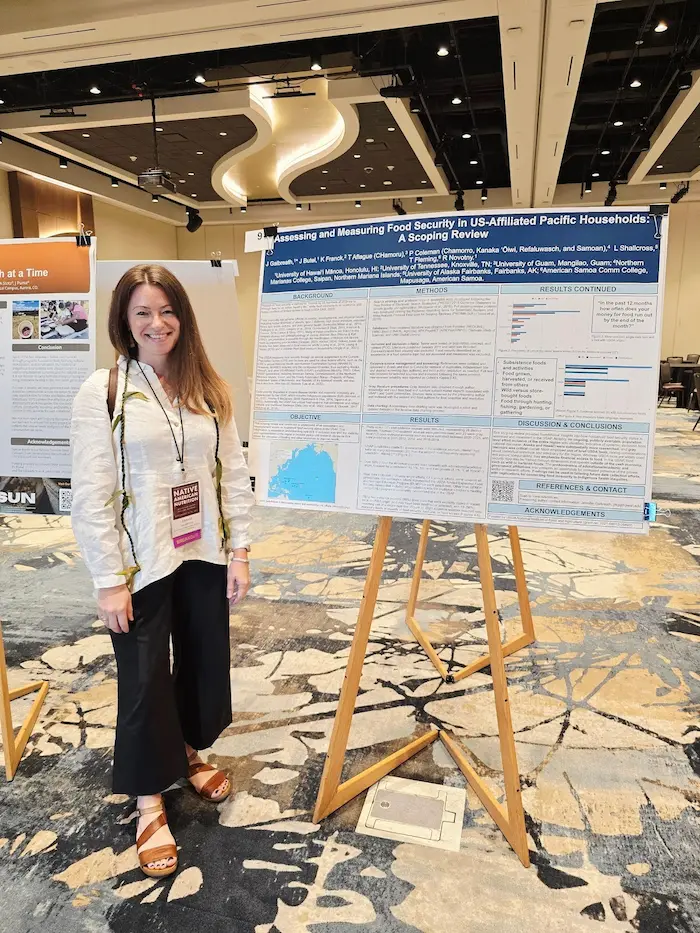
In terms of research and publications, Jennifer also co-authored a paper on Group Model Building Workshops for Children’s Healthy Living in Current Developments in Nutrition (March 2025) and registered a scoping review protocol on an open-access platform on assessing food security in US-Affiliated Pacific Households (June 2024). She has been actively conducting the scoping review and presenting on the research process and preliminary results, including a breakout presentation in Kodiak, Alaska at the Alaska Food Policy Council’s Food Festival and Conference (March 2025) and a poster session in Prior Lake, Minnesota at the Seventh Annual Conference on Native American Nutrition (September 2025). These presentation opportunities have resulted in excellent conversation with professionals from around the nation, including the shift from food security to nutrition security, the future of food security data collection, and the importance of non-retail food in food security, especially in Indigenous and rural populations. She is now working on a manuscript for future publication.
Additionally, she recently joined the School Nutrition Working Group through the Alaska Food Policy Council in October 2025 and is currently participating in the month-long Centers for American Indian and Alaska Native Health (CAIANH) Short Program for American Indian Alaska Native Knowledge (SPARK) online course on American Indian and Alaska Native health through the Colorado School of Public Health. Mid month she also attended the 2025 Alaska Federation of Natives (AFN) Convention in Anchorage. The AFN Convention is the largest representative gathering of Native peoples in the US and annually brings thousands of people from across Alaska together. With the theme of “Standing Strong, Stand United,” policy and government issues critical to Alaska Native peoples were addressed. Jennifer listened in to the passing of multiple resolutions specific to access to wild and subsistence foods, addressing rural food deserts, improving locally produced food procurement for Tribes, confronting food insecurity crises, protecting salmon, and more. Understanding these resolutions is helpful to Jennifer in exploring how her research interests and the skills gained in her PhD program can be used in the future in Alaska to support health, nutrition, and food systems priorities.
Jennifer is enjoying autumn foliage, family trail walks with a new puppy, a freezer full of summer berries, salmon, and moose, and watching the termination dust (snow) start making its way down the peaks of the Chugach Range mountains that surround Anchorage. She is excited to be back in her community and connecting with local projects and colleagues.